01
Two distinct traditions
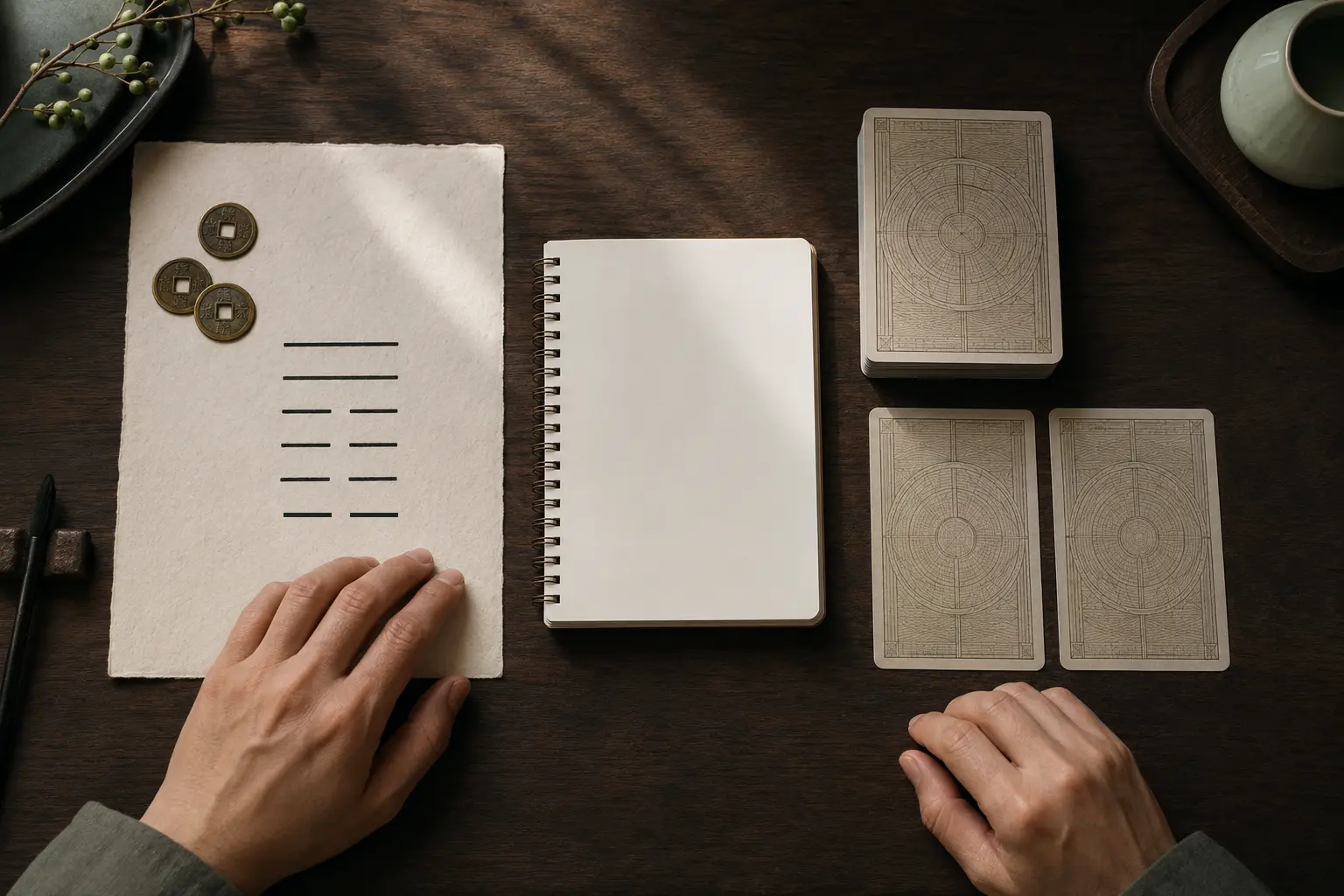
Tarot developed through European card traditions and is now practiced through many schools and spreads. The I Ching (易经), or Book of Changes, emerged from Chinese textual and divinatory traditions. An I Ching reading commonly forms a hexagram of six lines, sometimes with changing lines that point toward another configuration.
Both can support reflection, but similarities in purpose do not erase differences in language, history, and practice.
02
Image and change
Tarot often works through visual symbolism across a selection of cards and their positions. I Ching interpretation centers on a hexagram, its line structure, textual traditions, and the dynamics of change. Some practitioners use coins or yarrow-stalk methods; the physical method is only one part of the interpretation.
03
Questions that work well
An I Ching question is strongest when it describes a real situation and seeks perspective: What should I understand about approaching this collaboration? What factors deserve attention before this move? Questions demanding a guaranteed yes, an exact date, or control over another person reduce a nuanced method to false certainty.
04
Choosing responsibly
Choose the tradition whose method and cultural frame you want to engage. Then check what the service actually delivers. A clear offer should explain the report, protect your private question, avoid fear and dependency, and leave the final decision with you. The $29 I Ching Clarity Reading at Jade Compass Studio addresses one focused question in a concise Word or PDF report with practical decision prompts.
Sources & context
Further reading beyond this studio
These links provide primary-text access and scholarly context. They are not presented as proof that any personal reading is certain.
Book of Changes · Chinese Text ProjectPrimary Chinese text, received commentarial layers, and historical translation access.↗Metaphysics in Chinese Philosophy · Stanford Encyclopedia of PhilosophyScholarly context for polarity, cycles, correlative cosmology, and the Five Phases.↗Twenty-Four Solar Terms · UNESCOCultural-heritage context for knowledge of time and practices developed through observation of the sun’s annual motion.↗Related service
Planned after Sep 10 $39$29Published opening priceThrough Sep 10, 2026 · Beijing timeI Ching Clarity Reading
A concise, personally interpreted response to one focused question using the I Ching (易经), the Chinese Book of Changes.
View service details